How to Communicate Data Impact: The Complete Guide for Data Leaders and Professionals
Mar 02, 2026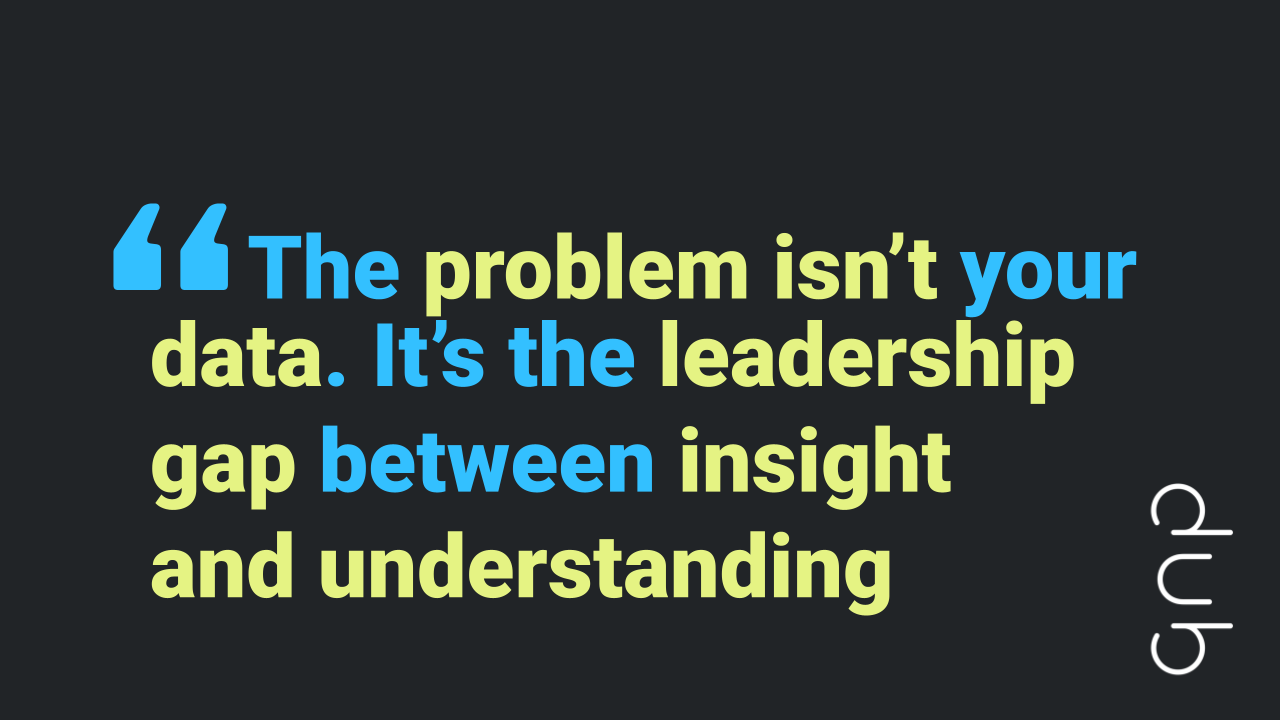
by Fiona Crocker & Sarah Burnett | Co-Founders, Dub Dub Data
You have the data. You have done the analysis. The insights are solid. Yet somehow, you walk out of the executive meeting feeling invisible, your work acknowledged with a polite nod and promptly forgotten.
If this sounds familiar, you are not alone. Across many data teams, the biggest non-technical challenge is not analytics capability or project management. It is the ability to communicate impact in a way that lands with a stakeholder and drives action. In fact, 38% of data professionals identify this as their number one struggle.
The problem is not your data. The problem is the leadership gap between what the data shows and what your audience understands - and more importantly, what they actually care about. This guide will walk you through the frameworks, mindset shifts, and practical techniques that help data leaders and professionals communicate their impact in ways that genuinely land and build trust.
👀 Prefer to watch instead?
We’ve dedicated an entire episode of our unDUBBED podcast to Communicating Impact and Delivering Value. Skip the scroll and view here.
Why Data Leaders Struggle with Effective Communication
The Leadership Communication Skills Gap in Data Teams
Most data professionals have been trained in analytics and technical data skills. They know how to validate models, interpret data points, and build forecasts. But they have rarely been taught leadership communication skills or effective communication in leadership contexts.
Many data analysts can explain model accuracy in detail. But key stakeholders are not evaluating statistical precision, they are evaluating organisational risk, cost, growth, and team performance. This is where the leadership gap appears. The ability to communicate well is a core leadership skill, yet it is often underdeveloped in highly technical environments.
Why Communicating Data Is Harder Than It Looks
The root cause of poor data communication is not a lack of insight. It is a surplus of complex data delivered without translation. You can present many data points and still fail to communicate effectively. Your audience may be nodding politely while internally disengaging. Not because they lack intelligence, but because the message is not framed in a way that connects to their organisational priorities.
Communicating data requires more than accuracy. It requires relevance.
The Hidden Cost of Poor Communication in Leadership
When communication in leadership breaks down, the cost is not just missed recognition. It is missed opportunity. If leaders are using data but do not fully understand it, decisions stall. If stakeholders to share context are not engaged early, alignment suffers. If team members feel valued only for output but not influence, morale drops.
Communication is vital for both personal and professional success and broader organisational outcomes. The good news? Communication skills are trainable.
Step One – Build Communication Skills by Listening First
How Successful Data Leaders Communicate Before They Present
Before you want to communicate your value, pause. Successful data leaders understand that leaders must be able to listen before they lead. Strong listening skills — and more specifically active listening skills — are foundational to effective leadership communication.
Before presenting, ask your stakeholder:
-
What is keeping you up at night?
-
Which key performance indicators are under pressure?
-
Where is the board pushing hardest right now?
This approach fosters open communication and helps build trust early. It also allows you to use data in a way that aligns directly with organisational pain.
Listening as a Core Leadership Skill
Many data team members assume their audience understands the context. That assumption is often wrong. Listening is not waiting to respond. It is clarifying, checking assumptions, and identifying the data related to real-world pressure points. When you develop effective listening habits, you enhance their communication and create alignment before persuasion begins.
Turning Stakeholder Concerns into Data Impact
Here is a practical example. Before presenting a recommendation to reduce customer churn using a propensity model, instead of opening with model accuracy, ask your Chief Revenue Officer: "What is your biggest concern heading into Q3 around revenue retention?" Listen to the answer. You will likely find they are worried about a specific customer segment or a product category - and suddenly you can frame your entire model around exactly that fear. You are no longer presenting a data project. You are presenting a solution to the thing that is keeping them up at night.
That framing shift - from "here is what the data shows" to "here is how we solve the problem you told me about" - is everything.
Step Two – Align Communication in Leadership with Business Pain
How to Communicate What Actually Matters
The single most powerful question a data leader can ask a stakeholder before any presentation or pitch is: "What challenges are you facing right now?" or more pointedly, "What is keeping you up at night?"
When you can open a conversation by naming the exact problem your audience is wrestling with, you throw the hook. You create immediate relevance. And once they are hooked, you reel them in slowly with evidence, examples, and credibility.
Effective Communication in Leadership Starts with Relevance
Consider this scenario. You have built a forecasting model that improves inventory accuracy by 22%. Instead of leading with the percentage, find out first that your Supply Chain Director is constantly under pressure because stockouts are creating complaints and the board is asking questions. Now your opening line becomes: "I know stockouts have been a persistent issue and it is creating noise at board level. I want to show you something that addresses this directly." The 22% lands completely differently in that context. It goes from a metric to a lifeline.
This approach - leading with their problem, not your solution - is rooted in the principles of persuasion that researchers like Robert Cialdini have studied for decades. People are far more motivated by what relieves a pain than what adds a gain. When you can demonstrate that your data work directly alleviates a known, named problem, your value becomes undeniable.
Step Three – Translate Complex Data for Non-Technical Teams
Communicating Data Through Business Language
Technical experts often default to technical language. But if you want to effectively communicate across different communication styles, you must translate. Complex data should become business language.
Replace precision metrics with outcomes.
Replace system architecture explanations with relatable analogies.
Replace volume with consequence.
That is effective data storytelling.
Best Practices for Communicating Complex Data
Think of it like being a skilled interpreter. You know both languages fluently - the language of data and the language of business outcomes. Your job is to bridge them. A few practical ways to do this:
Replace model metrics with business outcomes. Instead of saying "our model achieved 91% precision," say "out of every 100 customers we flagged as at-risk, 91 were genuinely at risk - meaning we can focus retention spend where it actually matters." Same insight, completely different impact.
Replace technical process descriptions with analogies. Instead of explaining that you built a real-time data pipeline with event streaming architecture, say "think of it like a live scoreboard for the business - the moment something changes in operations, the numbers on the dashboard update instantly." Analogies and metaphors create common ground across diverse audiences.
Replace volume with consequence. Instead of "we processed 4.2 million transactions," say "we identified 14,000 transactions that showed signs of fraud - that is $6.3 million in potential losses we can now investigate before they hit the books."
The goal is not simplification. It is relevance. You are showing them the same truth through a window they can actually see through.
Step Four – Leadership and Communication Through Storytelling
Why Storytelling Improves Effective Leadership Communication
Storytelling is one of the most powerful communication strategies available to data leaders.
Rather than listing data points, structure your message:
-
Here is the challenge
-
Here is what the data shows
-
Here is what we recommend
This structure helps your audience care about the data rather than just observe it.
Turning Reports into Narratives That Drive Action
A good data story has a beginning, middle, and end. It has tension and resolution. It has a protagonist - usually the business or the customer - facing a challenge, and a turning point where the data reveals something important.
Here is an example of the same finding told two ways.
Report version: "Customer lifetime value for the 25-34 age cohort declined by 18% YoY in the Southern region, driven by a 23% increase in churn in months 3-5 of the customer lifecycle."
Story version: "Imagine a customer who signs up, loves the product in the first month, and then quietly disappears before they ever really get started. That is what is happening with thousands of our 25-34 year old customers in the South. They are walking out the door right when they should be hitting their stride - and we now know exactly when and why. Here is what we can do about it."
Both versions contain the same data. Only one of them moves people to act.
Data Visualisation as a Leadership Communication Tool
Data visualisation is a critical part of this storytelling toolkit. A well-designed chart that draws the eye to the key insight, annotated with a single sentence that explains what the viewer is seeing, can do more work than three pages of analysis. The picture tells the story. Your job is to make sure it tells the right one.
Step Five – Influence Without Authority: Communication in Leadership
Building Leadership Communication Skills Without a Title
One of the most common frustrations for data professionals is feeling like they lack the authority to drive change. They do not sit on the executive committee. They do not have budget sign-off. They are brilliant individual contributors who cannot get traction.
Trust as the Foundation of Successful Leadership
Here is the reframe: authority is overrated. Trust is what actually gets things done.
People who have built influence without formal authority share a common approach. They self-manage first - they know what they want to say, why it matters, and they do not let emotion hijack the conversation in the moment. They know their audience deeply - not just their name and title, but how they think, how they process information, what their personality is like under pressure. And they tailor everything accordingly.
If your stakeholder is introverted and detail-oriented, you do not walk into their office with a high-energy verbal pitch. You send them a pre-read. You give them time to think. You follow up with a quiet conversation rather than a public presentation. Matching someone's communication style is not being inauthentic - it is being respectful.
How Data Leaders Earn Influence Through Communication
When you show up consistently, when you are genuinely in service of solving problems rather than proving you are right, trust compounds. And once someone trusts you, they do not need to be convinced - they come to you.
A practical example: a data analyst who consistently frames insights around the problems their stakeholders have mentioned in passing, who follows up meetings with brief written summaries, and who openly acknowledges when the data is uncertain rather than overstating confidence, will develop a reputation for being reliable and trustworthy. That reputation becomes influence. And that influence outlasts any job title.
Step Six - Advocate For Yourself With Confidence and Radical Candor
Radical Candor as a Leadership and Communication Strategy
There is a version of advocating for your work that comes from ego - "I am right and you are wrong, and here is the data to prove it." And there is a version that comes from genuine care - "I believe this matters for the business, and I want to make sure we are not missing something important." These two approaches land completely differently.
Radical candor means being direct and honest while also caring personally about the outcome and the people involved. It is not bluntness. It is not aggression. It is the courage to say something important paired with the wisdom to say it at the right moment, in the right way.
How Successful Data Leaders Communicate Under Pressure
For data professionals advocating for their findings, this means pausing before you react when someone pushes back on your work. It means asking yourself: is this person in a headspace right now where they are able to genuinely hear what I am saying? It means making sure your framing comes from "here is what I believe serves the organisation" rather than "here is why I am correct."
And in meetings where you feel unheard, the most powerful tool is often a quiet, confident restatement. "I hear what you are saying, and I want to make sure I understand your concern. Can I show you the data from a different angle?" That is radical candor in practice - direct, grounded, and generous.
Step Seven – Overthinking, Confidence and Leadership Skill Development
When Analysis Paralysis Blocks Communication
Data professionals are, by nature, analytical. They see patterns everywhere. They connect data points. And sometimes that same analytical superpower becomes a liability - they overanalyse situations, spiral into self-doubt, and freeze when they need to move forward.
If you recognise this in yourself, the first step is simply to name it. Realising you are in a spiral is already progress. From there, the move is to get outside your own head - talk to someone you trust who is not in the thick of the same situation, who can offer perspective without amplifying the analysis.
A useful question to break the spiral: "Is anyone genuinely harmed if this does not go perfectly?" In most data environments, the honest answer is no. Perfectionism is a form of self-protection, not a form of excellence. Done and useful beats perfect and delayed every time.
The reminder "perfect isn't done" is worth pinning somewhere visible if this is a pattern you recognise.
The Data Impact Framework for Successful Leadership and Communication
A Repeatable Model for Effective Communication in Leadership
To communicate data impact effectively, bring together everything in this guide into a repeatable approach:
Start by listening deeply to your stakeholders before you build anything or pitch anything. Understand what is keeping them up at night and what problems they are actually trying to solve. Then, frame your work entirely around those problems - not around your methodology or your tools. Translate your findings into business language using concrete outcomes, relatable analogies, and vivid numbers that connect to decisions. Tell a story with a beginning, middle, and end that gives your audience a reason to care. Build trust over time by showing up consistently, tailoring your communication style to your audience, and being honest about uncertainty. And when you advocate for your work, do it from a place of genuine service to the organisation, not a need to be proven right.
Becoming a Successful Data Leader Through Better Communication
Communicating data impact is not about making your work simpler. It is about making it more human. Your insights have the potential to change decisions, redirect investment, and create real outcomes in the world. The only thing standing between that potential and reality is whether the right people understand what you have found - and whether they trust you enough to act on it.
Your work matters. Now go make sure people know it.
About Us
We help organisations get more out of their Tableau investment. Better dashboards, cleaner data storytelling, and visualisations that actually influence decisions. If your Tableau setup is underperforming or your business users are not engaging with the data, we should talk
unDUBBED Podcast - D33 From Insight to Influence: Communicating Value and Delivering Impact with Sharon Lim
Follow us on your favourite platform:
🎙️ Unscripted. Uncensored. Undeniably data.
Summary
In this episode of Undubbed, Fiona and Sarah discuss the challenges professionals face in communicating their impact and value. Joined by Sharon Lim, a leadership coach, they explore the importance of effective communication, the role of storytelling, and practical tools to articulate one's value. The conversation delves into overcoming analytical overthinking, the benefits of LEGO Serious Play in fostering creativity, and the principles of radical candor in advocacy. Listeners are encouraged to understand their audience, listen actively, and influence without authority.
Takeaways
- 38% of professionals struggle with communicating their impact and value.
- Listening to others is crucial for effective communication.
- Everyone has a unique story that shapes their behavior.
- The blue sky metaphor represents our inherent beauty beyond struggles.
- Radical candor involves being direct while caring personally.
- Influencing without authority is possible through trust and respect.
- Using metaphors can help bridge communication gaps.
- Self-management is key to effective advocacy.
- LEGO Serious Play can unlock creativity and insights.
- Hope and collaboration are essential in overcoming challenges.
Chapters
- 00:00 Introduction to Communication Challenges
- 02:40 Sharon Lim's Journey and Coaching Philosophy
- 12:40 Understanding Impact and Value in Communication
- 22:12 Overcoming Analysis Paralysis and Finding Clarity
- 24:16 Navigating the Funk: A Path to Clarity
- 25:36 The Power of Letting Go
- 25:59 Self-Care: The Foundation of Productivity
- 28:54 Lego Serious Play: Unlocking Creativity
- 33:33 Radical Candor: Advocating for Yourself
- 43:15 Influencing Without Authority: Building Trust
Links
Connect with Sharon Lim  / coachsharonlim
Robert Cialdini – Influence: The Psychology of Persuasion https://www.amazon.com.au/influence-P...
Keywords
communication, impact, value, coaching, leadership, storytelling, radical candor, influence, self-management, LEGO Serious Play
Stay connected with news and updates!
Join our mailing list to receive the latest news and updates from our team.
Don't worry, your information will not be shared.
We hate SPAM. We will never sell your information, for any reason.